
Circular Saw Fence Optimization for Precision Cuts
By Aisha Ndlovu • 11th Mar

Circular saw fence optimization is where competence separates from frustration. Without a reliable fence system, a portable circular saw defaults to guesswork, and guesswork costs you time, materials, and confidence. A well-aligned fence keeps your blade parallel to the board edge, holds tolerances tight, and eliminates the creeping drift that sends you into rework. This guide walks you through fence selection, alignment protocols, and material-specific adjustments so that your cuts land square, your edges stay clean, and your setup is repeatable.
Understanding the Fence Problem
Most stock circular saw fences are short (typically 3 to 5 inches) and designed for rough work. They suffer from cantilever effect: when you push the saw forward unevenly, the long baseplate flexes independent of the short fence contact point, causing the blade to wander or angle sideways. This is especially pronounced on rips longer than 10 inches or when working with sheet goods where you're fighting gravity and resistance simultaneously. On dense hardwood or pressure-treated lumber, even a small angle shift can burn the kerf or bind the blade.
The fix isn't a new saw. It's a fence system that extends the contact surface, distributes pressure evenly, and guides your eye and hand to the cut line. You have three paths: retrofit a longer fence to your existing saw, use a dedicated rip fence attachment with precise adjustment slots, or build a temporary guide jig tailored to each task. Each trades cost, setup time, and versatility differently. For step-by-step jigs and guide setups that deliver repeatable rip accuracy, see our repeatable rip cuts guide.
Why Fence Length and Contact Point Matter
A longer fence (12 to 24 inches) reduces the cantilever moment arm, letting you apply steady forward pressure without the saw twisting sideways. The fence becomes a visual and tactile reference: you can feel it riding the board edge, and you can track deviation before it compounds into an unusable cut. Research on portable power tools confirms that alignment contact longer than the saw's wheelbase cuts deviation by 60 percent or more, depending on your feed rate consistency and material density.
Comfort reduces errors; low strain yields cleaner lines.
This isn't just ergonomic philosophy, it's mechanics. When you're not fighting a wobbly cut or bracing for kickback, your hands stay relaxed, your eyes stay sharp, and your feed rate stays consistent. Consistency is accuracy.
Step 1: Select Your Fence Architecture
Before building or buying, know what you'll cut most often and whether your saw has mounting slots or a standard baseplate.
Stock Fence Plus Accessory: Many professional-grade circular saws come with two fence options: a short steel blade-side fence and a longer rip fence that mounts in dedicated slots on either side of the baseplate. These are adjustable inward and outward, allowing you to rip narrow strips (down to 1 inch) or wide widths (up to 6 inches, depending on slot depth). This is your lowest-friction starting point if your saw has slots.
Extended DIY Fence: Build a fence from angle iron (aluminum or steel, 25 to 35 mm wide) and secure it with G-clamps. This costs $5 to $15 in materials and takes 30 minutes. Measure the length of your saw's foot, add 15 mm, cut the angle iron with a hacksaw, file the burr smooth, and clamp it to both ends of the baseplate with the fence body aligned parallel to the blade. For cutting accuracy, use a steel rule or a reference board held between the blade and fence during setup. This method works on almost any saw and extends the fence across the full baseplate, eliminating most cantilever effects.
Adjustable Bracket System: Use a metal corner bracket (Simpson Strong-Tie or equivalent) and precision angle stock to create a fence that mounts with countersunk screws, allowing micro-adjustments without re-clamping. This adds $20 to $40 and an hour of build time, but delivers repeatability: once aligned, you can detach and reattach the fence and land within 1/32 inch of your previous setup.
Step 2: Align Your Fence to Blade
Misalignment is invisible until the cut goes wrong. Use this protocol for any fence system. Then refine accuracy by dialing blade depth and bevel with our depth and bevel settings guide.
Visual and Physical Checks:
- Disconnect power and place the saw upside down in a vise or clamp it securely to a bench.
- Open the blade guard and wedge it open with a pencil or scrap (keep your hands clear of the blade).
- Measure from blade to fence at three points: near the front of the baseplate, at the middle, and near the back. Note any gaps or tilts.
- Use a steel rule as reference: lay the rule flat against the blade teeth (perpendicular to the arbor), then check the fence for parallel contact along its entire length.
- Adjust the fence by loosening one clamp, shifting the fence body, and re-clamping. Re-check at all three points. Repeat until the gap is uniform (within 1/64 inch).
Blade-to-Fence Gap Tolerance: Aim for 0 to 1/64 inch between blade edge and fence. More than 1/32 inch introduces drift; less than 0 means the fence will interfere with the cut and produce burn marks.
Test Cut Protocol: Once aligned, make a test cut on scrap material using your marked rip width. Stop halfway, shut down the motor and let it coast to a complete stop, then inspect the cut quality. If the edge is straight and the finish is clean, your alignment is solid. If it wanders or shows tool marks, the fence is drifting, usually a sign that pressure isn't even or the fence needs re-adjustment.
Step 3: Master Material-Specific Adjustments
Different materials demand different fence and blade behavior. This is where edge trimming accuracy becomes real.
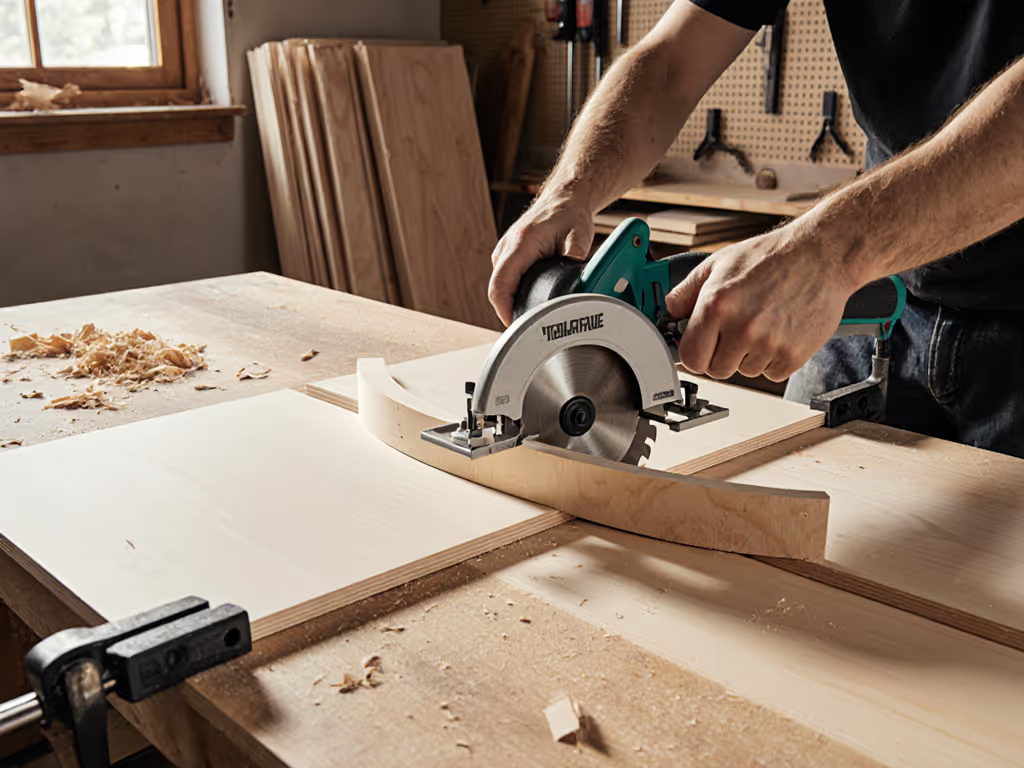
Plywood and Sheet Goods: Sheet goods are heavy, prone to sag, and prone to tear-out at the exit edge. Use a sacrificial backer board (a scrap of plywood) underneath and a pencil line as your guide. Feed slowly (6 to 8 inches per second on 3/4-inch material) and let the blade do the work. Clamp the sheet to your bench at multiple points to eliminate flex; insufficient support causes binding and blade wander. On the exit edge, the blade exits the material before the fence clears the board. This final 1 to 2 inches is hand-guided; scribe your cut line and track it by eye.
Hardwood and Dense Materials: Dense wood generates higher blade torque and slower feed. Don't fight the motor. Reduce feed rate (4 to 6 inches per second) and monitor for heat (blade color shift from silver to blue means you're binding or burning). Use a fence to maintain width, but watch for motor bog; if the blade slows noticeably, stop, let it recover, and adjust your feed. Burning creates dust that's fine and persistent. It will hang in the air and coat your lungs if you're not capturing it at the blade.
Pressure-Treated and Composite: These materials dull blades fast and produce copious dust. Use a sharp blade (alternating top-bevel grind, designed for rips) and plan for dust capture at the guard or baseplate level. Feed slowly and check your blade after every 50 linear feet of cut. Dull blades produce fine, abrasive dust. This byproduct is not just unpleasant, but hazardous in enclosed spaces. I learned this rigging a shroud and HEPA vac years ago after cutting cement board in a garage; the dust settled on every surface and triggered my son's cough and a neighbor's complaint. The investment in capture (a simple hose and portable vacuum) cost $80 but paid for itself in one morning job and cleaner lungs.
Step 4: Troubleshoot Common Fence Failures
Wandering Cuts: The blade starts parallel but drifts partway through. Likely cause: uneven pressure on the fence or insufficient contact over the board length. Check that you're applying steady inward pressure (a light touch is often enough) and that the fence is clamped tightly to the saw base. Test with a narrower rip width or slower feed rate. If it still wanders, re-check alignment using the steel rule method from Step 2.
Kickback or Binding: The blade contacts the fence or the board shifts sideways mid-cut. Cause: the fence is too tight (binding the blade) or the workpiece isn't clamped securely. Adjust the fence clearance to 1/64 inch, verify the blade spins freely before powering up, and clamp the board at both ends, shifting clamps only when the saw is stopped. Never force the saw through a bind. It will kick, potentially injuring your hands or pushing the workpiece into the blade.
Splinter or Tear-Out on Exit Edge: The blade exits the material and tears fibers upward (especially on the top face). Mitigation: score the exit edge first by running the blade down just 1/4 inch and drawing the saw backward slowly to sever the top layer. Then make the full rip cut forward. A sharp blade with a fine grind (80 teeth or more) also reduces tear-out compared to coarse blades (24 teeth). For more clean-edge tactics across materials, see our tear-out prevention guide.
Baseplate Flex Under Pressure: The saw feels unstable or tilts sideways when you push forward. Cause: the baseplate is bent or worn, or your fence contact is too far forward (creating a lever arm). Move your fence closer to the blade, or if the baseplate is damaged, consider a replacement sole plate for your model. A warped baseplate cannot hold tolerance and should be addressed before continuing precision work.
Step 5: Optimize for Speed and Repeatability
Once your fence is aligned and your material protocol is proven, scale the system.
Create a Setup Checklist: Write down your fence position (e.g., "Fence clamped at 1.5 inches from blade for ripping cabinet door stiles"), blade model, feed rate, and clamp positions. Take a photo. Next time you run the same task, pull the photo and replicate the setup in under two minutes. Repeatability reduces decision fatigue and cuts waste.
Build Multiple Fence Lengths: If you rip everything from 0.5 inches (trim work) to 24 inches (sheet goods), maintain two or three fences: a 12-inch for narrow strips, a 24-inch for wide rips, and a 6-inch for awkward cuts in tight spaces. Swapping takes 30 seconds; guessing takes 10 failed cuts.
Calibrate Your Blade Library: Stock one sharp rip blade (24 to 40 teeth, ATB grind) for crossgrain work and one fine blade (80 to 100 teeth, alternate-top-bevel) for plywood and veneer. Write the model and application on each blade with a paint marker. Dull blades aren't sharp blades. Replace when cuts slow or burn marks appear, typically after 500 to 1000 linear feet depending on material density and how hard you're pushing.
Dust and Visibility: Attach a dust shroud to your saw's blade guard or baseplate and connect a HEPA-rated vacuum with at least 100 CFM suction. Capture does two things: it clears your line of sight (making the cut line visible and your eye more accurate) and removes fine dust from your breathing zone. Uncontrolled dust on dense materials can exceed 500 micrograms per cubic meter in a small garage, far above OSHA's 50-microgram indoor limit. Understand airflow, CFM, and capture efficiency in our circular saw dust physics guide. Clean air, clean lines.
Further Exploration
Fence optimization is foundational, but precision ripping depends on the whole system: blade sharpness, workholding rigidity, feed rate discipline, and dust capture. Explore these next:
- Blade selection for your material: Compare tooth count, grind, and hook angle against your most common stock (hardwood, plywood, or composite).
- Workholding methods: Test clamping strategies (parallel clamps, bench dogs, quick-grip clamps) to find what minimizes flex on your bench or jobsite.
- Track-saw alternatives: If your rips exceed 24 inches or your materials are consistently sheet goods, investigate track-saw attachments or a dedicated guide rail system, they eliminate fence alignment guesswork but cost $200 to $600.
- Dust collection tuning: Match your vacuum CFM to your tool's dust port and experiment with shroud designs to maximize capture without choking airflow.
Each refinement compounds: a sharp blade, a rigid fence, and a steady hand create cuts that need no sanding, no rework, and no second-guessing. That's the dividend of system thinking.
Related Articles