Circular Saws for Wildfire Zones: Performance Ranked
By Ravi Kulkarni • 6th May
Wildfire zone construction isn't cutting plywood in your garage. When you're framing a deck or installing siding in a zone classified for fire risk, your material list changes (fire-treated lumber, intumescent boards, mineral wool barriers). And your circular saw for wildfire zones has to work differently too. The densified chemistry of fire-resistant material cutting demands faster blade speeds, cooler operation, and flawless accuracy because a remake of a fire-barrier panel doesn't just cost time; it breaks your punch list rhythm.
I've learned that lesson the hard way. On a condo build, a tiny inconsistency in our cut angles (nothing dramatic, just a 1 degree drift) forced us to remake eight stair treads coated in fire-retardant finish. That callback erased a day's profit and taught me that jobsite realities beat brochure promises every single time. Since then, I've rebuilt how we standardize cuts, and it starts with selecting the right saw and setup for the job ahead.
Why Wildfire Zone Cutting Is Different
Fire-resistant lumber and pressure-treated stock behave unlike commodity softwood. Fire-retardant wood cutting presents three immediate challenges:
- Harder grain and denser cellular structure: Chemical treatment adds mass; blade bite is tougher, motor load climbs, and dust generation spikes.
- Higher operating temperatures: Friction builds faster. A saw that coasts through regular framing can overheat or seize in treated material within an hour of continuous cutting.
- Dust compliance and cleanup: Fire-treatment chemicals create dust you cannot ignore. OSHA silica limits apply, and on residential jobs, clients notice (and object to) the residue.
A wildfire building code compliant saw isn't just a marketing tag (it is a tool selected and set up to maintain cut precision and temperature stability when cutting material that fights harder against the blade). For material-specific techniques, see our fire-resistant lumber tactics.
Performance Criteria That Matter for Wildfire Zone Work
Throughput Without Compromise
A circular saw that bogs, stalls, or forces you to ease off the feed rate costs money. On a full day of fire-treated lumber cutting techniques, a saw that maintains consistent RPM under load shaves hours off your schedule. Measured RPM drop under full load (no-load rated speed vs. cutting speed) reveals which models preserve torque. For a deeper dive into torque under load and RPM stability, read our performance metrics guide. Look for saws that hold ±10% of rated speed in dense material, not ±20% or more, which signals a motor that's struggling.
Cut Quality and Repeatability
A wandering line or a 2 degrees bevel drift on a treated panel means a remake. Your saw needs a baseplate rigid enough to resist deflection under pressure, and a mounting system for guides that doesn't creep or drift. Repeatable accuracy across dozens of cuts in one shift separates tools that stay on the truck from tools that create callbacks.
Dust Control Integration
Fire-retardant dust isn't optional to manage. A saw with a sealed dust port, low-impedance air-path design, and tested vacuum compatibility (standard 1.25" and 2.5" ports) keeps cleanup localized and keeps you compliant. Saws that dump dust into the air force you to mask, ventilate, or delay work for dust to settle, all throughput killers.
Thermal Stability and Runtime
Battery saws are standard now, but not all platforms handle sustained, high-load cutting equally. Learn how modern cells and thermal management affect power in our battery technology guide. Saws using newer 18V to 20V platforms with larger amp-hour ratings (5.0 Ah or higher) maintain voltage and motor speed longer under treated-lumber loads than lower-capacity packs. If you're running a full day, runtime without swapping batteries or waiting for rests directly impacts your completion time.
Setting Up Your Cut Station for Consistency
Less fiddling, more finishing... this is not a slogan, it is a requirement in wildfire zone construction work. Every member of your crew needs to execute the same cut the same way, or you get drift.
Blade Library by Material
Fire-treated lumber cuts best with specific blade profiles:
- 40-tooth, 4-edge grind: Optimal for crosscuts on treated stock; reduces tear-out and heat buildup versus fine-tooth blades that clog.
- 24-tooth, hook grind: Ripping treated material; the aggressive hook clears chips faster and resists friction stalling.
- 60-tooth, alternating-top-bevel: For veneered fire-barrier panels; protects the face and back from chipping.
Label blades by material and mount them on a pegboard visible to any crew member. No guessing, no swaps mid-job.
Guide System and Baseplate Alignment
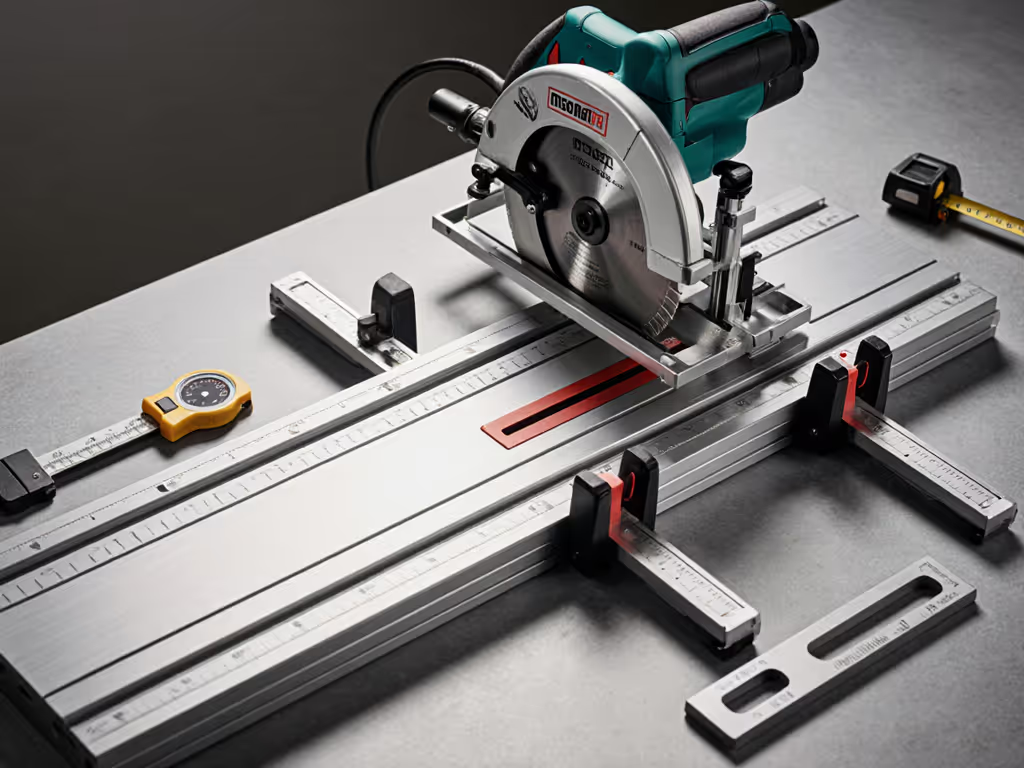
A track system or retrofit guide rail ($50 to $200) is a multiplier for cut accuracy. Compare track vs rip guides to pick the right path for your crew. Clamp a guide to your stock, lock your saw to the guide, and the tool does the steering. No hand-wobble, no drift. For crew consistency, this is non-negotiable. Test the alignment quarterly: dust, vibration, and thermal cycling loosen bolts and shift guides.
Dust Capture Plumbing
Connect your saw's dust port to a 16+ gallon shop vac (2.0+ peak horsepower for suction). Use a hose diameter that matches your saw's port (do not step down to 3/4" if your saw has a 1.25" port because suction drops 60%). Test the setup: make a crosscut and observe whether dust stays in the vac or blows out into the space. If air escapes, reposition the vac collection point or upgrade the hose diameter.
Blade Selection for Fire-Resistant Material Cutting
Not all blades are equal when cutting treated wood and fire-barrier composites. A blade optimized for drywall or metal doesn't cut treated lumber, it overheats and spalls.
Ideal specifications for treated-material blades:
- Carbide-tipped teeth (not steel; carbide holds hardness at higher temperatures).
- Expanded kerf (0.095" to 0.105") to reduce friction and friction-induced heat.
- Anti-stick coating (PTFE or similar) to minimize gum and resin buildup on treated chemical residue.
- RPM rating at least 1.5x your saw's maximum speed (for DeWalt, Makita, or Milwaukee models typically 4,000 to 6,000 RPM, select blades rated 5,500 to 6,500 RPM for headroom).
A quality treated-material blade costs $35 to $50 but outlasts cheaper blades 3 to 5 times when fed correctly. On a job cutting 100+ linear feet of fire-treated lumber, blade longevity directly impacts productivity and waste.
Dust Compliance and Cleanup in Wildfire Zone Work
OSHA Silica and Fire-Retardant Dust
When cutting fire-retardant materials indoors (renovation in an occupied home, interior remodeling), your dust capture rate must exceed 85% to stay within OSHA PEL for crystalline silica. A corded circular saw (vs. a battery model) allows unlimited runtime, which is a plus, but dust collection depends entirely on setup, not the tool. For capture principles and airflow targets, see our dust physics guide.
Action items:
- Use a dust shroud (aftermarket or factory-integrated) that encloses the blade partially and directs chips toward the vac port.
- Position the shop vac exhaust outside or through a HEPA filter.
- Mark cut-station boundaries with tape and discourage crew walk-through during cutting.
- Vacuum the work area post-cut; do not sweep or blow (re-aerosolizes dust).
Material Waste and Rework Prevention
On fire-barrier panels and treated decking, material cost is 30 to 50% higher than standard lumber. A remake due to a miscut or chipped edge isn't just time, it is cash. This is why precision setup and blade selection return measurable ROI. Every first-try cut that doesn't need re-work is a callback prevented and a panel saved.
Comparing Performance Under Load: Real-World Scenarios
Scenario 1: Ripping 2x10 Fire-Treated Joists (10 Linear Feet)
Standard handheld circular saw + 40-tooth blade:
- Cut time: 8 to 12 minutes (handheld, feed rate varies by operator confidence).
- Accuracy risk: Medium-High (prone to drift on long rips without guide).
- Dust capture: 60 to 70% (basic shroud, standard vac).
Corded circular saw + 24-tooth treated-material blade + track guide:
- Cut time: 5 to 7 minutes (guided feed, steady RPM on corded platform).
- Accuracy risk: Low (guide enforces line).
- Dust capture: 85%+ (full shroud integration, concentrated vac suction).
Throughput advantage: Track-guided + corded setup saves 3 to 5 minutes per rip and eliminates tape-measure corrections post-cut.
Scenario 2: Crosscutting Fire-Barrier Panels (30 Crosscuts, 48" Stock)
Battery handheld + 40-tooth blade, unguided:
- Per-cut time: 45 to 60 seconds (positioning, aligning, cutting).
- Total time: 22.5 to 30 minutes + battery swaps.
- Accuracy: ±1/8" (acceptable for many framing tasks, risky for finished surfaces).
Corded circular saw + cross-cut fence/miter guide:
- Per-cut time: 20 to 30 seconds (fence holds angle, repeatable stop positions).
- Total time: 10 to 15 minutes (no battery anxiety).
- Accuracy: ±1/16" (fit-ready for finished carpentry).
Labor savings: The fenced setup trades mobility for speed and precision, ideal for high-count, repetitive crosscuts on consistent stock thickness.
System Building for Consistency Across Crews
In my experience, consistency across crews beats peak spec. It sounds counterintuitive (shouldn't the fastest saw win?), but on a job where you're rotating two crews across two buildings, your bottleneck isn't the saw; it's the variation. One crew leaves a 2 degrees drift in their bevels; the other holds ±1%. The site supervisor catches rework mid-way, and now you're re-cutting panels and re-training.
Related Articles