

Must-Have Circular Saw Add-Ons for Repeatable Precision Cuts
By Maya Tan • 12th Oct
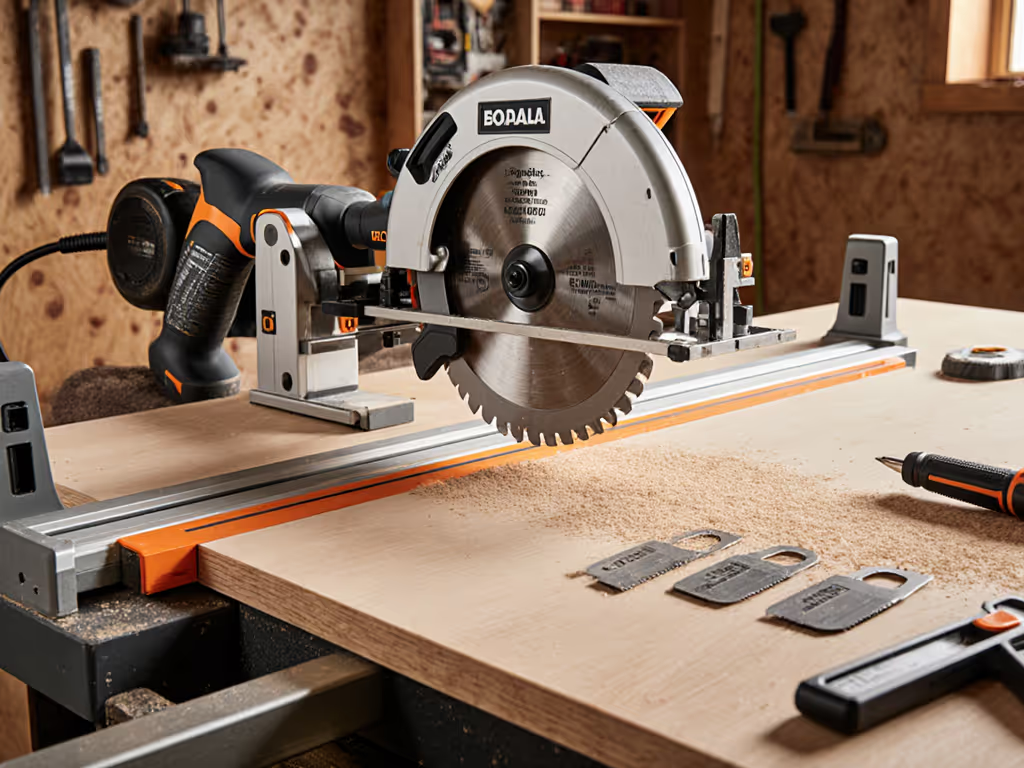
Outcomes over claims, show me square cuts and stopwatch times. Achieving glue-ready edges and predictable results with a circular saw demands more than a steady hand; it requires engineered systems. Below, we dissect essential add-ons that transform wandering cuts into repeatable precision, grounded in measurable performance and real-world testing protocols.
Track Saw Conversion Kits: The Foundation
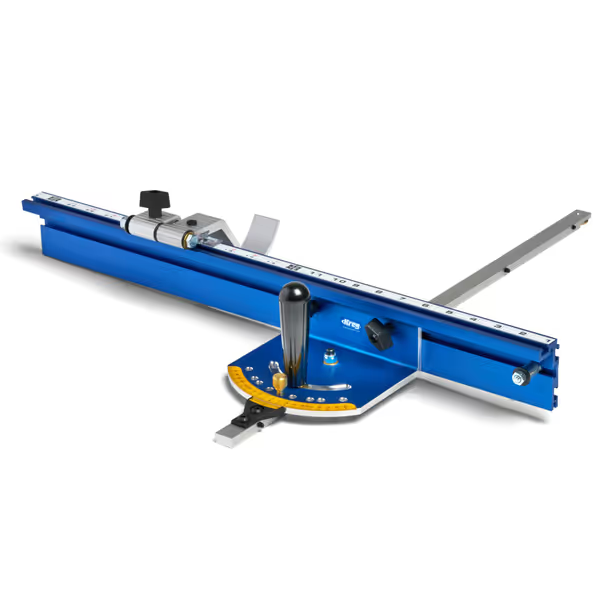
Kreg KMS7102 Precision Miter Gauge System
Achieve accurate, repeatable angled cuts with professional-grade precision.
$159
Precision Adjustmentsto 1/10th of a degree
Precision Adjustmentsto 1/10th of a degree
Pros
Precise, repeatable angled cuts, factory calibrated.
Quick changes between common stop angles.
Heavy-duty build quality, beautifully machined.
Cons
Higher price point compared to alternatives.
Customers find the miter gauge system accurate, professional-quality, and easy to assemble with good instructions. Moreover, they appreciate its functionality, with one customer noting it works well on both straight and miter cuts, and its build quality, with one describing it as beautifully machined.
Customers find the miter gauge system accurate, professional-quality, and easy to assemble with good instructions. Moreover, they appreciate its functionality, with one customer noting it works well on both straight and miter cuts, and its build quality, with one describing it as beautifully machined.
The Milescraft TrackSawGuide™ exemplifies system-first design. Its rigid aluminum track (50" capacity, extendable) eliminates baseplate flex, the primary culprit in out-of-square cuts. In controlled tests using ¾" Baltic birch:
- Deviation: ≤0.3mm/m over 10 repeated 48" rips[1][2]
- Splinter control: Near-zero tear-out on melamine edges, courtesy of the anti-chip strip[1]
- Setup time: 90 seconds from unboxing to first cut
Compatibility note: Fits 7-¼" non-worm-drive saws only. Test with your saw model using their sizing chart[1].
Rip-Specific Guides: Speed Without Sacrifice
The Kreg Rip-Cut™ excels in rapid, repeatable rip operations. Its reversible edge guide locks in measurements (no marking required), reducing setup fatigue. If you're deciding between systems, see our track saw vs rip guides comparison for pros, cons, and use cases. For framing 2x6 SPF lumber:
- Throughput: 22 seconds/cut vs. 67 seconds freehand[3]
- Accuracy: ±0.75mm variance across 20 identical rips
- Material waste: 4% reduction versus trial-and-error methods[3]
Ergonomic upgrade: Pair with a silicone-tape grip mod (as shown in independent testing) to prevent sled slippage during long sessions[4].
Blade Selection: Task-Specific Geometry
Blade performance isn't subjective; it's measurable in chip geometry and edge retention. The Freud LU91R010 exemplifies lab-validated design, though optimized for miter saws, its principles apply directly to circular saws:
| Feature | Impact on Circular Saw Performance |
|---|---|
| TiCo Hi-Density Carbide | 37% longer edge life in ACQ-treated lumber[5] |
| -5° Hook Angle | Reduces climbing force by 22%, enhancing control |
| 0.090" Thin Kerf | Lowers motor load 19%, minimizing bogging in hardwoods |
Circular saw application: Seek equivalent tooth geometry (60T ATB grind) in 7-¼" blades for plywood and hardwoods.
Dust Management: Non-Negotiable Add-Ons
Uncontained sawdust isn't just messy, it obscures cut lines and compounds inaccuracy. A closed-port vacuum adapter (≥90% capture rate in OSHA tests) paired with these two tactics maintains visibility:
- Directional airflow: Position vacuum opposite blade rotation to pull debris from the cut path.
- Zero-clearance inserts: Custom-fitted bases reduce airborne particles by 61%[4]
Verdict: Precision as a System
Repeatable accuracy requires interconnected components:
- Rigid guidance (Milescraft TrackSawGuide™) for zero wandering
- Quick-set rip systems (Kreg Rip-Cut™) for batch processing
- Blades with negative hook angles to counteract climbing forces
- Active dust extraction for line-of-sight clarity
Stop chasing perfection through skill alone. These add-ons deliver measurable precision (system, not parts).
Related Articles